
Singapore buying guide · Sources checked 12 November 2026
A used-car deposit is not automatically refundable if you change your mind, your loan fails or an inspection finds a problem. Before paying a dealer, obtain the written refund policy and agree the specific conditions that matter to your purchase. The contract, applicable law and facts determine the outcome. Do not rely on a verbal assurance that the deposit is “safe”.
Read the refund policy before the money moves
Singapore’s Motor Vehicle Dealer Deposits Regulations require a dealer to give a consumer the refund-policy terms in writing before collecting a deposit. They also address ambiguity, retention of deposits and the dealer’s burden of proving compliance. These rules do not mean that every buyer can cancel for any reason and obtain a refund.
Ask for the full document, including referenced terms and handwritten additions. Read it before signing or transferring money. If one section says “non-refundable” and another describes refund conditions, ask how those provisions work together and have the agreed meaning recorded clearly.
Identify the contracting seller and the organisation receiving payment. If the car is on consignment, clarify who is acting as seller, who holds the deposit and who must make any refund. Do not assume that the person showing the vehicle is the contracting party.
Define the event that would let you withdraw
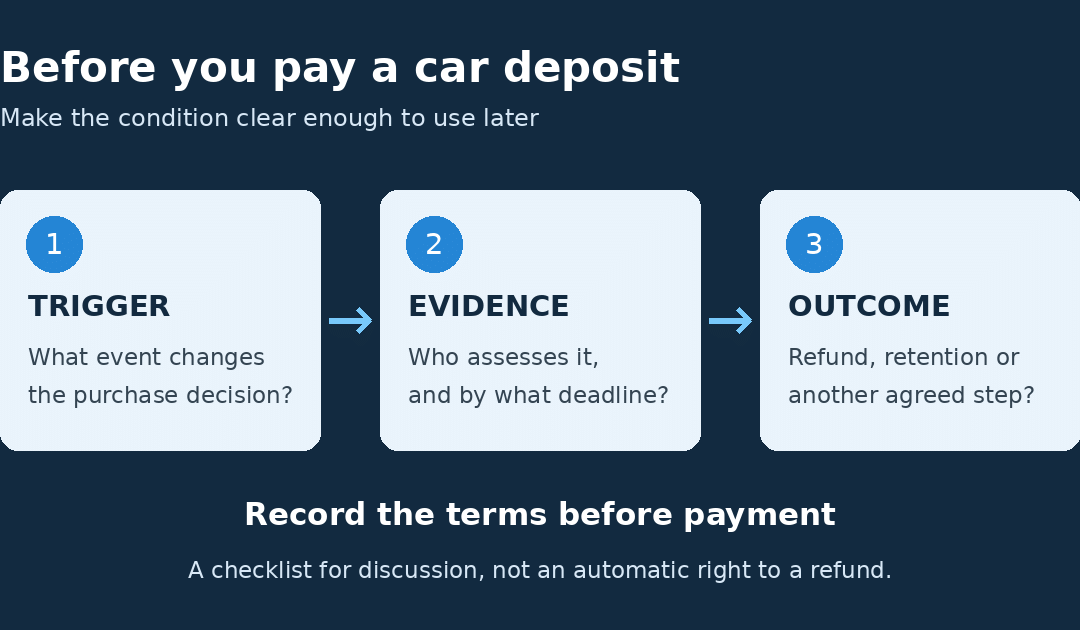
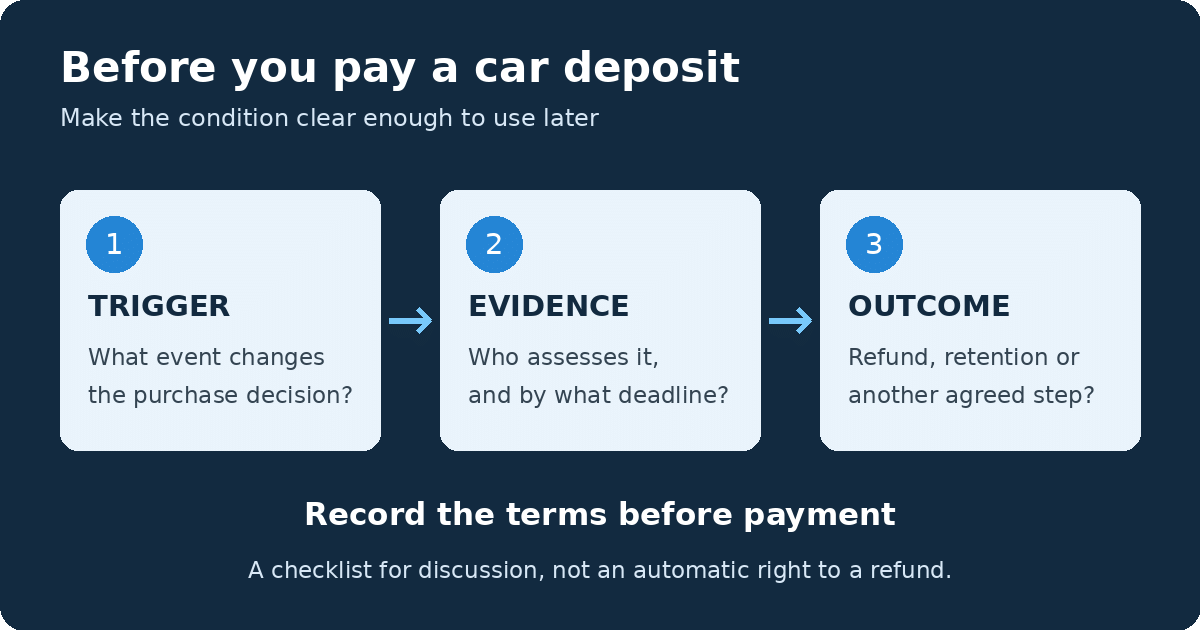
Start with the unresolved issue that prevents you from committing. Is it finance approval, an inspection finding, missing paperwork or a delivery deadline? Then ask what happens if that issue is not resolved. Broad labels can hide very different expectations.
On smaller screens, scroll the table sideways.
| Possible condition | Questions to settle in writing | Evidence to retain |
|---|---|---|
| Loan approval | Which application and deadline? What if the approved amount or terms differ from what you need? | Application details, lender response and the agreed finance condition. |
| Pre-purchase evaluation | Which provider and findings trigger cancellation or refund? Are any issues expressly excluded? | Full report, inspection date and vehicle identifiers. |
| Agreed repairs or documents | What must be supplied or completed, by when, and what happens if it is not? | Written undertaking, repair records and relevant correspondence. |
| Delivery timing | Is the date firm? What extension process and cancellation consequence are agreed? | Sale agreement and any later written changes. |
| Buyer changes their mind | Can the buyer cancel, and what amount, if any, is retained? | The cancellation/refund terms provided before payment. |
This is a discussion checklist, not a set of automatic legal rights or a ready-to-sign contract. If the answer matters to your decision, do not leave it as an assumption.
Make inspection conditions more precise than “subject to PPI”
Agree who selects and pays for the evaluation, when it will occur and what happens if access is delayed. Ask whether the decision depends on named findings, a defined grade or another specified standard. A general condition assessment and the contractual test for a refund are not necessarily the same thing.
A May 2026 Small Claims Tribunals judgment illustrates the problem. The dispute concerned an ambiguous written deposit-refund clause and a dealer’s narrower interpretation of engine and gearbox issues. The tribunal ordered a refund on that case’s wording and facts. The lesson is to make exclusions and thresholds clear beforehand, not to assume every mechanical observation guarantees a refund.
For example, if an agreement distinguishes “major” faults from wear, ask what that distinction means and who will assess it. Also specify the process if an evaluator recommends further diagnosis. The buyer and seller may otherwise reach different conclusions from the same report.
Check finance conditions separately
Do not equate submitting an application with receiving an acceptable loan offer. Before paying, decide which unresolved finance outcome you need the agreement to address. A rejection, a smaller approved amount and an offer on different terms are not identical events.
Ask how and when you must notify the seller, what lender evidence is required and whether an alternative proposal changes your obligations. Do not assume you must accept a replacement arrangement without reading its terms. If a clause leaves a consequential point unclear, obtain clarification or independent advice before signing.
Our used-car quotation guide covers price and finance comparison. Here, the priority is what happens to the deposit if a specified condition is not met.
Dealer-arranged finance also has specific safeguards. Regulation 4 addresses a timely application on the terms agreed by the consumer and, following rejection, a lender’s written statement supplied on request before the dealer exercises retention rights. An exception to these financing-specific requirements applies where the dealer proves that its failure to meet them did not cause or contribute to the circumstances resulting in retention. Read the full rule or seek advice for a disputed case; it is not an automatic refund promise whenever a loan is rejected.
Create a short payment record
Keep the signed agreement and the refund policy as provided before payment. Obtain a receipt identifying the parties, vehicle, amount, date and purpose of the payment. Confirm whether it forms part of the purchase price and retain proof of the actual transaction.
Save relevant advertisements and messages that explain the agreed conditions. If the arrangement changes, ask for an updated written record before making the next payment. A receipt confirms that money was paid; it may not contain the whole refund agreement.
If a deposit dispute arises
Write to the contracting business with a concise timeline, the relevant clause, supporting evidence and the outcome you seek. Keep the discussion factual. Ask for its response and explanation in writing rather than relying on repeated telephone conversations.
CASE’s complaint guidance describes assistance for eligible consumer-to-business disputes and the supporting documents to provide. It also explains its representation arrangements and further options. Eligibility, deadlines and remedies depend on the case; obtain appropriate advice rather than assuming a tribunal claim or chargeback will succeed.
Frequently asked questions
Does a “non-refundable” label settle every dispute?
No single label should be read in isolation. The full agreement, applicable deposit rules and facts matter. Resolve conflicting clauses before paying; seek advice if a dispute already exists.
Can I rely on a salesperson’s message?
Keep it, but ask for the refund conditions to be clearly incorporated into the written agreement before payment. Avoid leaving material terms scattered across inconsistent conversations.
What should I ask StarBright before reserving a car?
Confirm the specific vehicle and availability, request the applicable sale and deposit terms, and clarify any outstanding evaluation or finance conditions. Start with our pre-owned listings or request a test drive. This article does not state StarBright’s refund policy or promise that a reservation is available.
General consumer information, not legal advice on an individual agreement.