
Singapore buying guide · Sources checked 22 November 2026
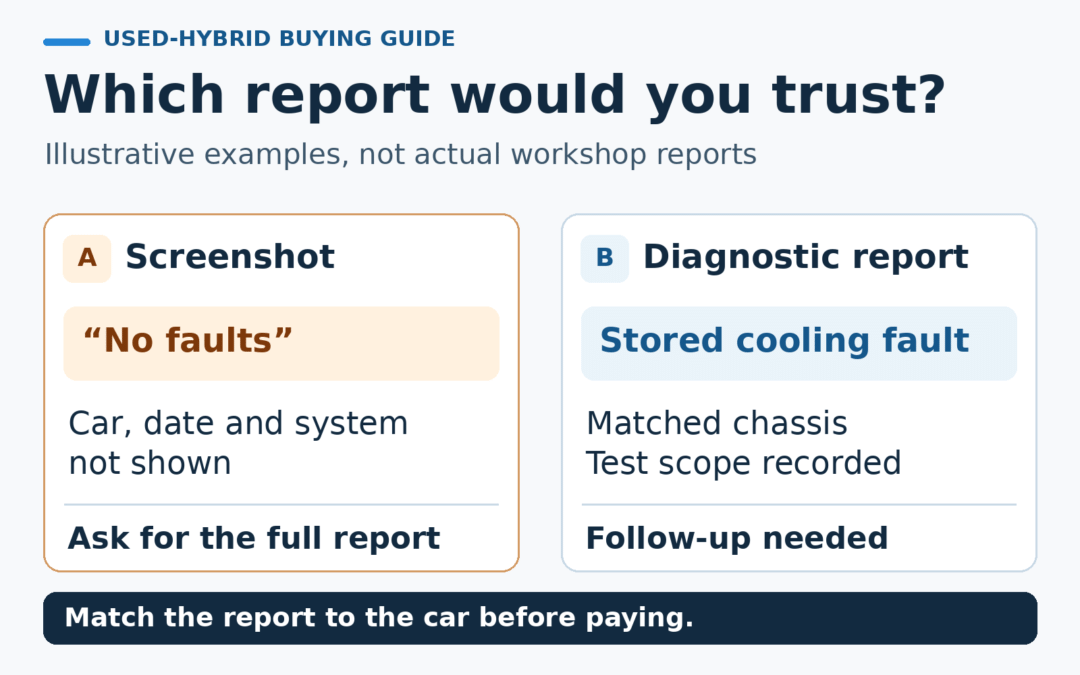
Two used hybrids of the same model and year are on your shortlist. The first seller sends a screenshot marked “No faults”. The second gives you a dated workshop report that lists a stored battery-cooling fault. Which car do you look at first?
I’d start with the second report, not necessarily buy the second car. It shows which car was tested, what the technician checked and what still needs explaining. The screenshot might be accurate, but you can’t tell which system was scanned. Neither is enough reason to pay a deposit yet.
This is an illustrative comparison, not a report for any StarBright Auto vehicle.
Same model. Two different reports.
Which car?
Which system?
When?
Hybrid system scanned
Stored cooling fault
Follow-up required
More useful evidence doesn’t mean a clean bill of health.
On this page: Compare the reports · Follow up on faults and repairs · Verify the warranty · Decide before paying
Compare what the two reports actually say
The key distinction is which battery the report is about. The high-voltage traction battery supplies the hybrid drive system; the low-voltage auxiliary battery powers electronics. A 12V test does not tell you whether the traction pack is healthy. Likewise, the Hyundai KONA Hybrid owner’s manual describes its dashboard gauge as showing remaining battery power. It’s the difference between how much charge is there now and what the pack can still do. For the two batteries’ roles, see the U.S. Department of Energy’s hybrid system guide.
On a small screen, scroll the table sideways to see the final column. Keyboard users can focus the table region and use the arrow keys.
| Find this on the report | Car A: a photo of the scan | Car B: a written workshop report | What to do with it |
|---|---|---|---|
| Car and test details | No chassis number, date or mileage shown | Chassis number matches the car; date and mileage recorded | Match the report to the actual car and compare the report mileage with the current odometer. |
| What the workshop checked | “No faults”; scanned system not shown | Names the hybrid control system and records battery readings while driving; says usable capacity was not measured | Ask what the test did and did not establish. A road test with live readings is not a measured capacity test. |
| Faults and their status | No detail on current or recorded faults | No current fault reported; a stored battery-cooling fault is listed, with no repair record supplied | Ask the workshop what the fault means, what would explain it and what follow-up it recommends. A stored fault is a lead, not a diagnosis. |
| Technician’s conclusion | No interpretation or next step | Cooling follow-up recommended; no battery replacement diagnosis | Have the recommended check done first. If it identifies a fault, ask for a written quote for the work on that car. |
The wording is simplified for illustration; your report may use different terms.
I’d ask Car A’s seller for the full workshop report or permission to get a hybrid-specific inspection. For Car B, I’d ask the workshop to follow up on cooling and put the results in writing. If the seller only has a general pre-purchase report, ask whether its scope included the traction battery on that exact variant. CASE’s SAFE Checklist notes that professional evaluation centres may not perform engine checks for some powertrains, including hybrid systems. Our second-hand premium-car checklist explains how to choose a pre-purchase evaluation for the rest of the car.
Follow the paper trail if the battery has been worked on
“Battery changed last year” might mean the 12V battery, a new traction pack, a used or refurbished pack, or work on part of the original pack. Ask for the invoice and look for the car’s identifier, the date and mileage, the part fitted and who did the work. Then ask whether the workshop tested the car afterwards. If the invoice only says “battery”, it doesn’t answer the question yet.
If the report lists an active warning or recommends further diagnosis, don’t treat a clean dashboard at the viewing as a second opinion. Ask the workshop whether it can explain the discrepancy. If a code was cleared during documented repair, ask for the repair record and the follow-up result. If you’re shown a state-of-health percentage, ask which tool produced it and what it measures for that model. Don’t compare two percentages unless you know the tests are comparable. Leave all work on the high-voltage system to a qualified workshop.
Ask the warranty issuer, not just the seller
Use the exact chassis number and ask the issuer to confirm in writing whether the car has traction-battery cover that will apply after transfer. Ask for the expiry date and mileage limit, which faults qualify, whether parts and labour are covered, and what happens if the pack has already been repaired or replaced. Check where you’d have to take the car and whether any transfer inspection or paperwork must happen before collection.
The distinction isn’t theoretical. Kah Motor’s published hybrid battery terms show a local example: transfer for eligible coverage is subject to an inspection and approval, not simply a change of ownership. That example doesn’t establish cover for a different seller, vehicle or repair. Use the StarBright used-car warranty guide to check the rest of your contract.
Decide before you pay a deposit
- Keep the car on your shortlist if the report matches the car, covers the traction battery and explains any findings. It still cannot tell you exactly how many years the pack will last.
- Get a specific check or quotation first if a fault is unexplained or a prior repair is undocumented. Ask what the inspection fee covers and what work would be needed if the fault is confirmed. Compare two cars over the same intended ownership period and remaining COE. Use the written estimate for the exact car rather than a generic battery replacement figure.
- Wait rather than pay to find out if the seller won’t allow the agreed check or won’t put the deposit terms in writing. If you do reserve first, agree who pays for the test, the deadline, what outcome would trigger a refund and what happens if the inspection cannot go ahead. Get the condition and refund timing on the reservation paperwork before paying. LTA’s used-vehicle transfer guidance also tells buyers to review deposit and warranty terms before signing.
Message to copy to the seller
“Could you send the full traction-battery report and any battery repair invoice for this car? Please confirm whether I can arrange a hybrid-specific inspection before paying a deposit. If a deposit is needed first, can you put the inspection deadline and the refund conditions in writing?”
Quick questions
Does a low reading on the battery gauge mean the pack is failing?
Not on its own. That gauge shows remaining charge; use the car’s manual and have any hybrid warning assessed rather than diagnosing the pack from the gauge.
Can a report without a health percentage still be useful?
Yes. A vehicle-matched report can explain which systems were checked, what faults were recorded and what needs further testing. It shouldn’t claim to have measured something it did not test.
Does a replacement pack make the car a safer buy?
It depends on what was fitted, how the car tested afterwards and whether any relevant cover remains. Ask for the original repair invoice and written warranty confirmation.
View a car with the paperwork in hand
Browse our pre-owned cars or book a test drive in Bukit Batok. Include the car you’re considering in your enquiry and ask which battery reports and service records are available before you visit.
Sources and model information
Sources checked 22 November 2026. Hyundai KONA Hybrid manual, hybrid system gauge · U.S. Department of Energy hybrid systems · CASE SAFE Checklist, professional evaluation · Kah Motor warranty terms · LTA vehicle transfer guidance. Confirm the exact model, market, model year, condition, and written warranty for the vehicle you’re considering.