
Singapore buying guide · Sources checked 22 November 2026
Imagine a fictional viewing in Bukit Batok. The listing says 67,200 km, and the dashboard agrees. Then you open a July service invoice showing 74,600 km. Which number should you use before deciding on a deposit?
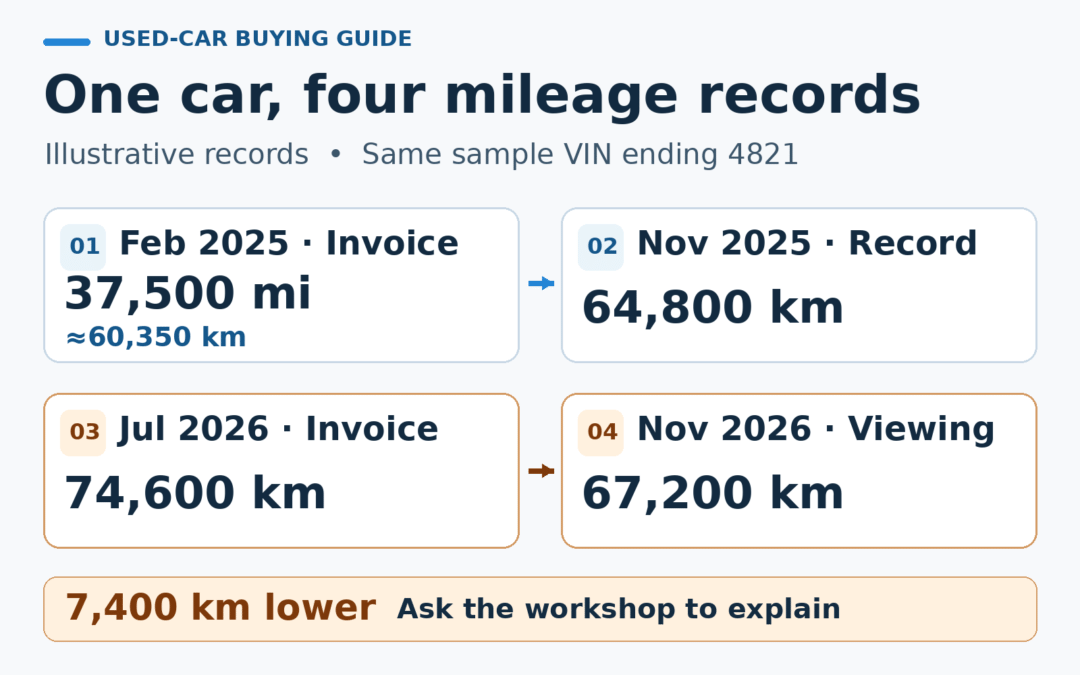
One car. Four dated readings.
Dated service invoice
Resolve the difference with records before relying on the mileage.
On this page: Match the records · Build the timeline · Ask the seller · Decide from evidence
1. Match each record to the exact car
Compare the full VIN or chassis number on the car with the available records. The suffix 4821 below is only an illustrative label; it is not enough to identify a real vehicle. If a record shows only a registration plate, ask for a record connecting that plate to the exact car.
Use the date when the service or reading was recorded, not merely the date a printout was produced. At the viewing, read the total odometer rather than the resettable trip counter. Keep the original distance and unit on your timeline, then compare the readings in a common unit. A miles-to-kilometres mix-up can create an apparent conflict.
2. Read every step in the timeline
In this fictional example, the first invoice uses miles. At 1 mile = 1.609344 kilometres, 37,500 miles equals 60,350.4 km, or approximately 60,350 km. Keep that conversion separate from the original reading.
On a small screen, scroll the table sideways. Keyboard users can focus the table region and use the arrow keys.
| Reading date | Record and sample car | Original reading | Comparable kilometres |
|---|---|---|---|
| 12 Feb 2025 | Dated invoice · VIN suffix 4821 | 37,500 mi | 60,350.4 km (approximately 60,350 km) |
| 18 Nov 2025 | Workshop printout · VIN suffix 4821 | 64,800 km | 64,800 km |
| 6 Jul 2026 | Dated invoice · VIN suffix 4821 | 74,600 km | 74,600 km |
| 22 Nov 2026 | Odometer at viewing · VIN suffix 4821 | 67,200 km | 67,200 km — 7,400 km below July |
The first three readings rise. The latest does not. Comparing only the oldest and newest would miss the problem: 67,200 km is higher than 60,350 km, but lower than the intervening July invoice. The July and November 2026 figures are already in kilometres, so converting the first invoice does not explain their difference.
3. Ask for the record that resolves the mismatch
Use a precise question rather than making an accusation:
“This July invoice for the same VIN shows 74,600 km, but the dashboard shows 67,200 km today. Can you check with the workshop and show me the record that explains the difference before I decide on a deposit?”
If the seller says the invoice contains a typo, ask for a corrected document or written confirmation from the workshop. Check that the correction refers to the same car, service date and original entry.
If the instrument cluster was replaced, ask for the dated job sheet and the recorded old and new readings. An invoice that says only “cluster replaced” establishes that work was listed; it does not establish the car’s total mileage. Keep the explanation and supporting records together.
4. Decide from the evidence you actually have
- Consistent readings: continue checking condition, servicing and the work now due. A consistent timeline does not diagnose the car’s condition.
- Gaps without an arithmetic conflict: ask for missing records and treat the unsupported period as unknown. Do not pay extra for a low-mileage claim you cannot verify.
- A newer, lower reading without supporting documents: pause. If the mileage affects your offer and cannot be reconciled, shortlist another car.
The CASE SAFE Checklist has a mileage field and a separate professional-evaluation section. An independent evaluation can help assess present condition; it cannot reconstruct missing mileage records. Our inspection guide explains how to read an evaluation’s scope. Use the premium-car checklist to consider repairs, servicing and COE alongside the mileage evidence.
5. Complete the checks before paying a deposit
- Write down the total odometer reading and its unit.
- Match the available records to this exact car.
- Put the reading dates in order and compare a common unit.
- Resolve conflicts with supporting documents.
- Decide whether the evidence changes what you are prepared to pay.
If you reserve the car while waiting for records, ask for a written deadline and a clear refund condition before paying. Specify what happens if the records do not arrive or do not resolve the mismatch. Our deposit guide explains the questions to settle.
Quick questions
Do incomplete records mean I should walk away?
Not automatically. A gap is less evidence, not proof of wrongdoing. Decide how much uncertainty you are willing to accept, assess the car’s condition and avoid paying a low-mileage premium without support.
Why is the listing lower than the current odometer?
The listing may be older and the car may have been driven since it was recorded. Check the listing date and distance unit. Ask for an explanation if the difference still does not make sense.
View the car with its records
Browse StarBright Auto’s pre-owned cars or book a test drive in Bukit Batok. Ask what mileage and servicing records are available for the exact car before you visit.
Sources checked 22 November 2026: CASE SAFE Checklist. Dates, VIN suffix and mileage readings in the worked example are fictional. Conversion: 1 mi = 1.609344 km.