
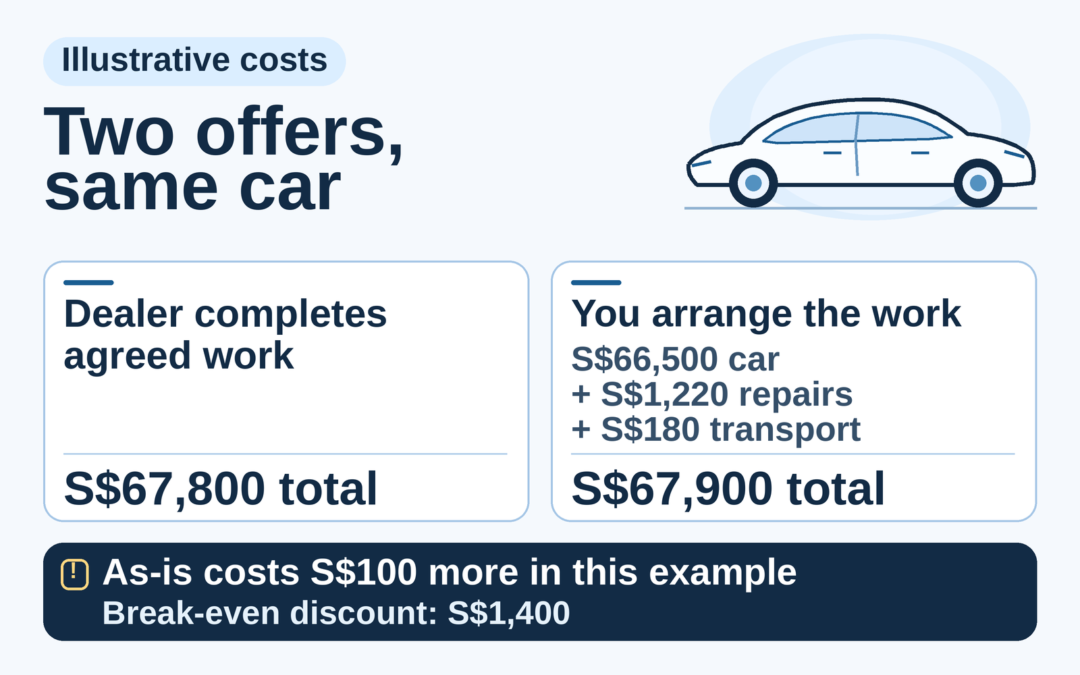
Two offers on the same fictional car. Add the quoted work and any costs of arranging it before comparing the lower as-is price.
Singapore buying guide · Sources checked 23 November 2026
In this fictional example, the car is S$67,800. The inspection report says two front tyres are nearing replacement and the driver’s window switch is faulty. The evaluator confirms that the tyre work can be scheduled rather than done before collection. The dealer can do the work before handover or sell the car as-is for S$1,300 less. Which offer leaves you better off once the same jobs are done?
Make both offers cover the same work
Start with the workshop quotation for the exact car. Ask it to split out the parts, labour and any extra operations, and confirm what’s included in the final price, including any applicable GST. Ask how long the quote is valid and when the workshop can actually do the work.
Now ask the dealer to price the same scope. A written offer to replace two tyres is not equivalent to a workshop quote for two tyres, fitting and alignment if the alignment isn’t included. Likewise, “repair window” leaves it unclear what will be done and who will check that the reported fault is gone. Ask the dealer to specify the work, the parts or standard agreed, and how they’ll verify the result.
If you are still deciding which inspection to arrange, read the pre-purchase evaluation versus LTA inspection guide first. The comparison here starts with a report you already have. CASE’s SAFE Checklist explains why an evaluation describes what could be assessed at the time; it isn’t a guarantee.
A S$1,300 discount that leaves you S$100 worse off
The buyer’s written workshop quote in this example lists S$780 for the two fitted tyres, S$120 for alignment and S$320 to replace the window switch, including parts, labour and any applicable GST. That’s S$1,220 for the named work. The buyer also expects to spend S$180 on transport while the car is at the workshop, bringing the cost of arranging the same work to S$1,400.
On smaller screens, scroll the table sideways.
| Dealer’s offer | What the buyer pays | What has to be true |
|---|---|---|
| S$67,800 with repairs before handover | S$67,800 | The dealer agrees to all three quoted jobs, pays for them and provides the agreed proof before collection. No extra transport cost for the buyer in this example. |
| S$66,500 as-is | S$66,500 + S$1,220 workshop quote + S$180 transport = S$67,900 | The evaluator has said the work can wait until after collection, the quote is still valid and you can make the appointment. |
| As-is, if a different significant fault still needs diagnosis | Not comparable yet | Get the fault assessed and costed before making an offer. Don’t treat an unspecified repair as a zero-cost item. |
The break-even discount is S$1,400 here, not S$1,220. At that discount, both offers cost the same after the work. If the buyer can genuinely avoid the S$180 transport cost, the as-is offer becomes S$67,720, or S$80 less than the dealer-repair offer. That may still not be enough to make a workshop trip worthwhile for this buyer.
These are illustrative figures, not StarBright Auto prices or typical repair costs. Both offers assume the same car, identical terms and charges other than the repair arrangement, and no other work in the calculation. If either offer changes other purchase terms, reconcile the full written quotations before comparing them.
Decide what has to happen before collection
Ask the dealer to fix it first when you don’t want to arrange the work yourself, or the evaluator says it should be completed before you use the car. Agree what counts as completion. For the tyres in the example, ask for the job record against the vehicle and the alignment printout if that was agreed. For the window, check that it works before you accept the handover. If a material finding needs a follow-up check, agree who will do it and when rather than settling for “already fixed”.
Take an as-is price when the job has a defined scope, the evaluator says it can wait, and the discount is worth both the cost and the hassle to you. A quote for a job you can book next week is different from an estimate that assumes parts no one has checked are available.
Pause or walk away if a significant finding is still undiagnosed, if the seller won’t let you confirm the work, or if what they are offering to fix keeps changing. In those cases you don’t yet have two comparable offers. A bigger discount doesn’t tell you what the problem is.
Put the offer you’re accepting into the agreement
For each job, keep one written record with the vehicle identifier, the finding from the report, the work and parts agreed, who pays, the completion date and what you will see before collection. If the work is late or the agreed evidence isn’t available, record in advance what happens to collection and any remaining payment. LTA’s safe transaction guidance also recommends putting the dealer’s verbal promises in the sale or service agreement. If you’ve already paid a deposit or are being asked for one, use the deposit conditions guide to check how those terms interact. An inspection finding alone doesn’t tell you what the agreement says.
Here’s a message you can send before accepting either offer:
Could you put both prices in writing for this car? For the repair option, please list each job from the report that you’ll do, what’s included, when it will be done and how we’ll check it before collection. For the as-is option, please confirm the revised total and which jobs I’m taking on. Please flag any other terms that would change.
Have a car on your shortlist?
Browse StarBright Auto’s pre-owned cars or request a test drive. Mention the specific listing and ask what assessment records are available and how to discuss any work you would want done before collection.