
Singapore buying guide | Sources checked 22 November 2026
Will fuel savings cover S$3,000?
Four-year comparison · Illustrative figures
Same assumptions: 6.8 vs 5.0 L/100 km · S$2.70/L
Two used cars in Bukit Batok suit your commute. The petrol car is S$65,000 and the hybrid is S$68,000. Both have enough remaining COE for the four years you plan to keep the car. The hybrid should use less petrol, but will that save S$3,000 before you sell?
On this page: Compare the two quotes · Calculate fuel payback · Stress-test the savings · Decide before you book
Compare the two quotes on the same basis
Start with two cars that meet the same needs. Compare similar age, size and condition, and note both exact variants. A higher-priced hybrid may also have lower mileage, newer equipment or a later registration date. Treat the difference in what you would actually pay as the real price gap, rather than assuming the whole gap is a charge for the hybrid system.
Ask for itemised quotes using the same payment and insurance assumptions. If one price depends on a dealer loan, insurance package or trade-in, ask for a comparable quote before calculating the premium. Use our guide to comparing used-car quotations to check which charges are included.
Then set a common holding period. If you intend to sell after four years, use four years, even if there are six years of COE left. If one car has only three years left, a four-year comparison silently assumes a renewal or a switch to another car. Compare them over three years or model that extra cost before calling it a fair comparison. Verify the exact expiry dates against the vehicle records and use LTA’s OneMotoring COE guide if renewal enters the decision.
Calculate how long the fuel savings take to recover the price gap
Use litres per 100 km for both cars. Pull fuel consumption for the exact year, engine and variant if available. LTA’s OneMotoring fuel guide and Fuel Cost Calculator are a starting point for comparing published figures. The model below uses a conventional, non-plug-in hybrid. A plug-in hybrid needs a separate calculation for petrol and electricity based on how often you charge it.
For this worked example, assume 6.8 L/100 km for the petrol car, 5.0 L/100 km for the hybrid, and the same fuel at S$2.70 a litre for both. Assume the cars each have more than four years of COE left and all quoted purchase costs are already included. These are invented inputs for comparing, not fuel-price quotes, test results or StarBright Auto stock.
Annual fuel cost = annual kilometres ÷ 100 × litres per 100 km × effective price per litre.
Annual fuel saving = petrol car’s annual fuel cost minus hybrid’s annual fuel cost.
Fuel-only payback = purchase-price premium ÷ annual fuel saving. If no positive saving remains, there is no fuel-only payback on those assumptions.
Scroll the table sideways to see the payback result. Keyboard users can focus the table region and use the arrow keys.
| Annual distance | Petrol fuel per year | Hybrid fuel per year | Annual saving | Saving over four years | Time to recover S$3,000 |
|---|---|---|---|---|---|
| 10,000 km | S$1,836 | S$1,350 | S$486 | S$1,944 | About 6.2 years |
| 20,000 km | S$3,672 | S$2,700 | S$972 | S$3,888 | About 3.1 years |
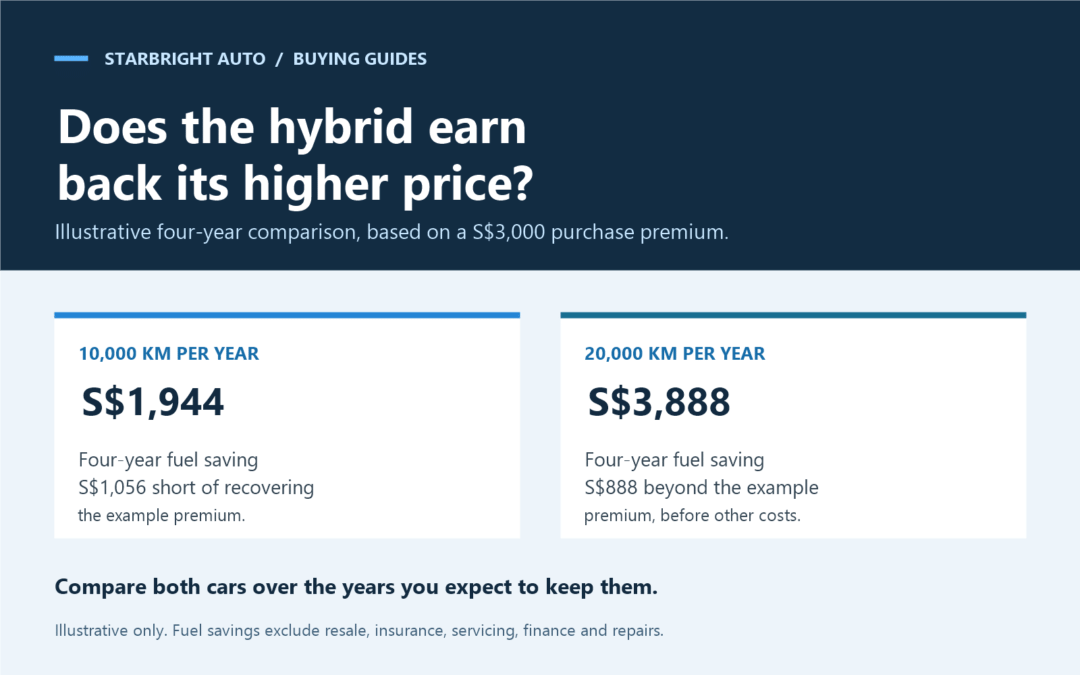
At 10,000 km a year, fuel savings are S$1,056 short of the premium at sale. At 20,000 km a year, they are S$888 more than the premium, before any other cost differences. Under these assumptions, a four-year fuel-only break-even takes about 15,400 km a year, or around 1,300 km a month. If your own recent driving is nowhere near that, the fuel savings alone are unlikely to explain the price premium.
Test what happens if the gap in fuel use is smaller
Use mileage from your own dated service records or odometer readings to estimate annual distance. Check whether that period reflects the coming years: a shorter commute, more work from home, school runs or a change in who drives can move the answer. Use the fuel price you realistically pay for the grade each car requires, after the discounts you actually use. If the grades or discounts differ, calculate the two fuel bills separately.
Don’t take a claimed consumption figure as a promise about your route. Use a second estimate for the fuel gap. At 20,000 km a year in this example, if the hybrid actually averages 5.8 rather than 5.0 L/100 km, and the petrol car remains at 6.8, savings fall from S$972 to S$540 a year. That gives back S$2,160 over four years and now leaves the purchase premium S$840 short. A small surplus in the first calculation is a reason to check the inputs carefully, not to stretch your budget.
Before deciding, get a road-tax figure and an insurance quote for each exact car. Compare the scheduled work that falls within the same ownership period. If a hybrid battery report flags something that needs investigation, get a vehicle-specific diagnosis or repair estimate; don’t assume a replacement is due or insert a generic battery cost. Our used-hybrid battery report guide explains what to ask the workshop for.
Decide how much extra the hybrid is worth to you
If fuel savings are your only reason to buy the hybrid, start with the saving over your intended holding period as your maximum extra price, using the conservative consumption assumptions you can defend. At 10,000 km a year in the example, that is S$1,944, not S$3,000. If fuel savings nearly cover the premium, compare the insurance, road tax, financing and maintenance differences before committing. For instance, just S$250 more per year in other costs would take S$1,000 out of the 20,000 km result over four years, more than the original S$888 margin.
If you’re counting on the hybrid selling for more later, record a separate estimate of the difference in what you’d actually receive when you exit. Don’t subtract the entire resale value from the price gap; only the difference between the cars belongs in this comparison. If you have no credible estimate, show the figures without it first. Our depreciation and COE guide explains how to compare purchase price with different exit values and periods.
Question to ask the seller:
Can you give me the itemised price for this exact car without a trade-in, its COE expiry, the fuel consumption figure for this variant, and the next major service that is due? I’m comparing it with another car over the same four years.
Quick questions
Does a hybrid always save enough fuel to be worth more?
No. In this example the lower-distance driver saves fuel but never recovers the premium during their four years of ownership. The cost of the exact car and how much you drive matter more than the type of powertrain on the listing.
Can I use the listing’s km/L number?
Check the variant and how it was measured. To compare it with an L/100 km figure, divide 100 by the km/L number. For example, 20 km/L equals 5.0 L/100 km. Run a less favourable set of inputs before relying on the advertised figure.
Compare the cars and their paperwork
Browse StarBright Auto’s pre-owned cars or book a test drive in Bukit Batok. Ask for the written quote and the COE expiry for the exact car you’re considering so you can compare it with your shortlist over the same period.
Sources checked 22 November 2026: LTA OneMotoring: Fuel and LTA OneMotoring: Certificate of Entitlement. Example prices, distance and consumption are illustrative. Totals are fuel-only unless an additional cost is specifically stated.